

Every experienced traveler has a short list of things they genuinely could not do without. The problem is that the internet has made it nearly impossible to find that list without wading through dozens of sponsored roundups pushing overpriced gear that looks great in photos but collapses under the weight of real travel.
This guide cuts through that. Whether you’re boarding a long-haul international flight, road-tripping across the country, or living out of a carry-on for two weeks, the travel accessories here are selected for one reason: they solve real problems that real travelers face.
We’ve organized everything by trip type, use case, and budget so you can skip straight to what matters for your next trip.
What Makes a Travel Accessory Actually Worth Packing
Before diving into specific products, it helps to understand what separates a genuinely useful travel accessory from one that sounds good on paper.
The best travel accessories share a few qualities. They solve a specific, recurring problem. They pull their weight meaning the value they deliver is proportional to the space and weight they occupy in your bag. And they work across more than one type of trip, so you’re not packing a different kit every time you travel.
Three questions are worth asking before adding anything to your bag. First: does this solve a problem I actually experience when I travel, or does it solve a problem I only think I’ll have? Second: would I notice if I forgot it? Third: can something I’m already bringing do the same job?
Gear that passes all three tests almost always earns its place. Gear that doesn’t usually ends up buried at the bottom of your bag.
One misconception worth clearing up: more expensive doesn’t always mean better for travel. Some of the most useful travel accessories are under twenty dollars. Some of the most overhyped are well over a hundred. Budget and premium options both appear throughout this guide because the right choice depends entirely on how often you travel and what kind of traveler you are.
Travel Accessories for the Airport and Flight
The airport and the flight itself represent the most uncomfortable, most unpredictable part of almost any trip. The right accessories here don’t make travel luxurious they make it manageable.
Neck Pillows and Sleep Accessories
A good neck pillow is one of the most personal travel purchases you’ll make, because comfort varies enormously from one person to the next. The inflatable variety saves the most bag space, but many travelers find memory foam versions far more comfortable for actually sleeping upright. Hybrid designs that pack down into a small pouch have become increasingly popular and represent a practical middle ground.
What to look for: a pillow that supports the sides and back of the neck, not just the back. Many cheaper options prop your head back without stopping it from falling sideways, which defeats the purpose on a long-haul flight.
Paired with a good neck pillow, a sleep kit makes a meaningful difference on overnight flights. The core pieces a quality eye mask and a set of earplugs or noise-blocking earbuds cost very little and dramatically improve the odds of actually sleeping in the air.
Noise-Canceling Headphones
For frequent flyers, noise-canceling headphones are one of the few travel purchases that justify a higher price point. The difference between a cheap pair and a well-engineered set of active noise-canceling headphones is not subtle, especially on long-haul flights where engine drone accumulates over hours.
For travelers who prioritize portability, in-ear options like the Apple AirPods Pro and Sony LinkBuds offer powerful noise cancellation in a genuinely pocketable form factor. For maximum noise reduction and audio quality, over-ear options like the Sony WH-1000XM series or Bose QuietComfort range remain the gold standard, though they take up considerably more bag space.
If you fly on older aircraft where Bluetooth entertainment systems are absent, a Bluetooth transmitter adapter a small device that plugs into the headphone jack and pairs with your wireless earbuds is an inexpensive solution worth knowing about.
Compression Socks
Compression socks sit firmly in the category of things many travelers dismiss until they actually try them. On flights over three hours, they help maintain circulation, reduce leg fatigue, and lower the risk of deep vein thrombosis a genuine concern on long-haul travel.
They don’t need to be medical-grade for most travelers. Light to moderate compression, in the 15-20 mmHg range, is sufficient for the vast majority of healthy adults flying economy. Merino wool versions are particularly worth considering because they regulate temperature well and resist odor useful if you’re wearing the same pair across a long day of travel.
Power Banks and Charging Essentials
| Capacity | Best For | Key Feature |
|---|---|---|
| 5,000mAh | Minimalists carrying only a phone | Adds almost no bulk |
| 10,000mAh | Single-device travelers | Charges most smartphones two to three times |
| 20,000mAh | Travelers carrying multiple devices | Covers phone, wireless earbuds, and smartwatch |
A portable power bank is one of the most universally useful travel accessories across every type of trip. Airports, train stations, buses, and hotel rooms with limited outlets all make a reliable external battery essential.
Capacity is measured in milliamp hours (mAh). A 10,000mAh power bank will charge most modern smartphones roughly two to three times. For travelers carrying multiple devices phone, wireless earbuds, smartwatch a 20,000mAh bank is worth the extra weight. For minimalists carrying only a phone, a slim 5,000mAh option adds almost no bulk.
Look for power banks with USB-C Power Delivery (PD) output if you also want to charge a laptop or tablet. The best options include a digital charge indicator so you’re never caught guessing how much battery remains.
A cable organizer or a small cable pouch is a simple addition that pays off immediately. Tangled cables in a bag pocket are a minor but persistent annoyance that a three-dollar organizer eliminates permanently.
Travel Wallets and Passport Holders
A dedicated travel wallet serves two purposes: it keeps your most important documents organized and accessible at security and boarding, and it protects them from damage during the trip.
Slim leather or fabric wallets that hold a passport, a few cards, boarding passes, and some cash cover the needs of most travelers without adding bulk. Bifold options with a passport sleeve work particularly well because they eliminate the need to carry a separate passport holder.
For international travel specifically, a passport holder with RFID-blocking material is worth considering. RFID skimming is a genuine (if overstated) threat, and the protection adds essentially no weight or cost.
Travel Accessories for Carry-On Packing
Carry-on travel has specific organizational challenges that dedicated accessories solve far more effectively than improvised alternatives.
Packing Cubes
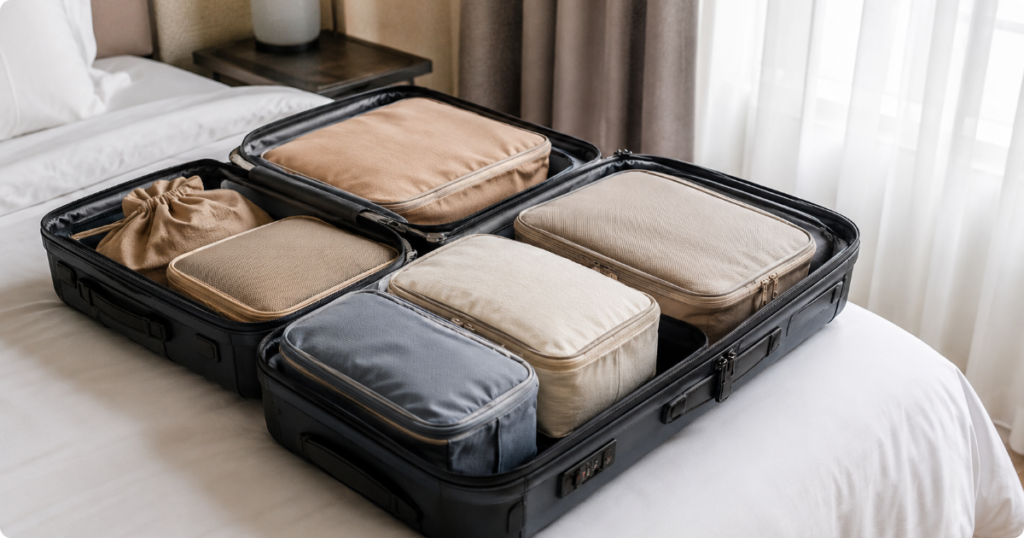
Packing cubes are one of the few travel accessories that deliver obvious value the first time you use them. They compress clothing, prevent wrinkles, and turn a chaotic suitcase into a system where everything has a specific place which matters most when you’re repacking quickly in a hotel room.
A basic set of three to four cubes in different sizes covers most packing needs. The most useful combination for a week-long carry-on trip is typically one large cube for clothing, one medium for undergarments and socks, and one small for accessories or a light layer.
Compression packing cubes which use a second zip to compress contents offer more packing efficiency but require more effort to pack and unpack. They’re worth the extra hassle for travelers who consistently push the limits of their bag.
For a deeper look at the best packing cubes, including specific picks across different bag sizes, see our dedicated [Best Packing Cubes] guide within this silo.
Toiletry Bags and Leak-Proof Bottles
The right toiletry setup depends entirely on your bag configuration. For carry-on only travel, the TSA 3-1-1 rule in the US and equivalent restrictions in other countries mean liquids must be in containers of 100ml or less, all fitting inside a single quart-sized clear bag.
Reusable silicone bottles in the 30ml to 100ml range are a practical upgrade over single-use travel-size purchases. Look for bottles with a secure flip or screw cap and a wide opening for easy refilling. The GoToob series and Cadence capsules are well-regarded options that hold up to repeated use.
A hanging toiletry bag one that hooks over a towel bar or door is worth the small extra weight if you’re moving between accommodations frequently. It removes the need to unpack toiletries onto a counter and makes everything accessible even in small bathrooms.
Luggage Tags and Bag Security
A luggage tag seems trivial until you watch bags circle an airport carousel unmarked and anonymous. A distinctive, clearly labeled tag with your name and contact information is the minimum. Many travelers now combine this with a digital luggage tracker (covered in the tech section below) for a complete solution.
For carry-on bags, a TSA-approved combination lock on any accessible exterior zipper adds a layer of security without creating problems at airport security. For checked bags, TSA-approved locks allow agents to open and relock bags without destroying the lock.
Travel Accessories for International Trips
International travel introduces a specific set of logistical challenges different power systems, connectivity gaps, and higher security stakes that a handful of targeted accessories address well.
Universal Travel Adapters
A travel adapter is non-negotiable for international travel. The world uses several incompatible socket types, and without the right adapter, your devices simply don’t charge.
There are two types worth knowing. A plug adapter changes the physical shape of your plug to fit a different socket it does not convert voltage. A voltage converter changes the electrical voltage, which matters for older devices that don’t support dual voltage. Most modern electronics (phones, laptops, cameras, e-readers) are dual voltage, meaning they accept both 110V and 220V automatically and only need a plug adapter.
Universal adapters that cover multiple socket types in a single unit are the most convenient option for travelers visiting multiple countries. Individual adapters for specific regions are lighter and more compact if you’re traveling to only one destination. A compact adapter with built-in USB-A and USB-C ports eliminates the need to carry a separate charging block, which is a meaningful space saving.
For a specific example: a 65W GaN charger with interchangeable plug ends (EU, UK, and US) covers the majority of countries worldwide in a single unit lighter than most traditional travel adapter blocks.
Anti-Theft Bags and RFID Wallets
Petty theft is a reality in many popular international travel destinations, and the right accessories reduce your exposure without requiring constant vigilance.
Anti-theft bags incorporate features like slash-resistant fabric, locking zippers, and hidden pockets. They’re worth considering for urban travel in high-tourist areas, though they’re not a replacement for basic awareness of your surroundings.
RFID-blocking wallets and cardholders prevent wireless scanning of chip-enabled cards and passports. The technology is legitimate and the protection adds no meaningful weight. Whether the risk justifies the investment depends on where you’re traveling, but for international trips to busy tourist destinations, RFID protection is a reasonable precaution.
A crossbody phone lanyard a strap that attaches through a phone case and keeps your device tethered to your body addresses one of the most common causes of phone loss and theft during travel. It takes about ten seconds to set up and provides constant passive security.
Portable Wi-Fi and SIM Card Solutions
Staying connected internationally without paying excessive roaming charges has become significantly easier with two options: portable Wi-Fi hotspot devices (also called pocket Wi-Fi or MiFi) and international SIM cards.
A pocket Wi-Fi device connects to local cellular networks and shares the connection with multiple devices via Wi-Fi. It’s the most flexible option for groups or for travelers using multiple devices, but it requires carrying and charging an additional device.
International SIM cards and eSIM plans which can be downloaded to a compatible device before departure have become the more convenient option for solo travelers. Many providers offer data-only plans covering dozens of countries at competitive rates. Checking your phone’s eSIM compatibility before departure is worthwhile.
Travel Accessories for Comfort and Convenience on the Road
Beyond the airport and the flight, several everyday accessories make the time between destinations significantly more comfortable.
Reusable Water Bottles
A good reusable water bottle is one of the simplest and most universally useful things a traveler can carry. It eliminates the cost and waste of buying bottled water at airports and tourist areas, and most airports now have water filling stations past security.
For travel, the best options balance capacity with weight. A 500ml stainless steel bottle is a practical size large enough to matter, small enough to fit in a bag side pocket. Insulated options keep drinks cold or hot but add significant weight. Non-insulated stainless steel is a useful middle ground.
Collapsible silicone bottles pack down to almost nothing and are worth considering for travelers who only occasionally need a bottle, or who want a backup option.
Packable Daypacks
A packable daypack a lightweight backpack that folds or rolls into a small pouch is one of the most underestimated travel accessories available. It weighs almost nothing in your main bag and becomes a fully functional day bag the moment you arrive.
They’re particularly valuable for travelers checking a bag who want to explore without dragging full luggage, or for carry-on travelers who want a separate day bag without the weight of a second structured bag.
The best options weigh under 100 grams when packed, offer a capacity of 15 to 20 liters when deployed, and use fabric strong enough to carry a day’s worth of gear, a water bottle, and a light jacket without tearing.
Eye Masks, Earplugs, and Sleep Essentials
Sleep quality during travel affects every other part of the experience, and a few small accessories make a significant difference. A quality eye mask preferably contoured so it doesn’t press against the eyelids blocks light effectively in hotel rooms with thin curtains and on aircraft with persistent cabin lighting.
Reusable silicone earplugs, such as those from Loop, offer better noise reduction and comfort than traditional foam earplugs and come with a carry case that keeps them clean between uses. They’re a meaningful upgrade over the earplugs airlines occasionally provide, and they work equally well in noisy hotel rooms, on trains, and on aircraft.
A compact travel pillow rounds out a functional sleep kit. The best options pack down to a size smaller than a water bottle and deploy quickly without an air pump.
Travel Accessories for Women
Women travelers often have overlapping priorities with the general list above, but a few categories carry additional weight.
Security and anti-theft tend to be higher priorities, particularly for solo female travelers in unfamiliar destinations. Crossbody bags with concealed pockets, slash-resistant straps, and RFID-blocking cardholders are worth prioritizing. A door alarm a small device that triggers an alarm if a hotel door opens unexpectedly is a low-weight addition that provides an extra layer of security.
Packing organization tends to matter more when a bag contains a wider variety of item sizes. A dedicated jewelry organizer (a small roll-up pouch with separate compartments) prevents tangles and keeps earrings, rings, and necklaces accessible and protected.
For long flights, a silk eye mask and a multi-use dry oil one product that works for hair, face, and body help manage the dehydrating effects of cabin air without requiring a large toiletry kit.
See our dedicated [Best Travel Essentials for Women] guide for a more detailed breakdown with specific product picks.
Travel Accessories for Men
For male travelers, the most commonly overlooked accessories tend to be in the comfort and organization categories. A well-designed toiletry bag, a reliable travel wallet that doesn’t bulk out a pocket, and a versatile packable jacket cover most needs.
Dopp kits hanging toiletry bags with a wide main compartment and organized interior pockets are the most practical format for men who carry a moderate toiletry load. Hard-sided versions protect glass bottles and cologne better, while soft-sided versions are lighter and more packable.
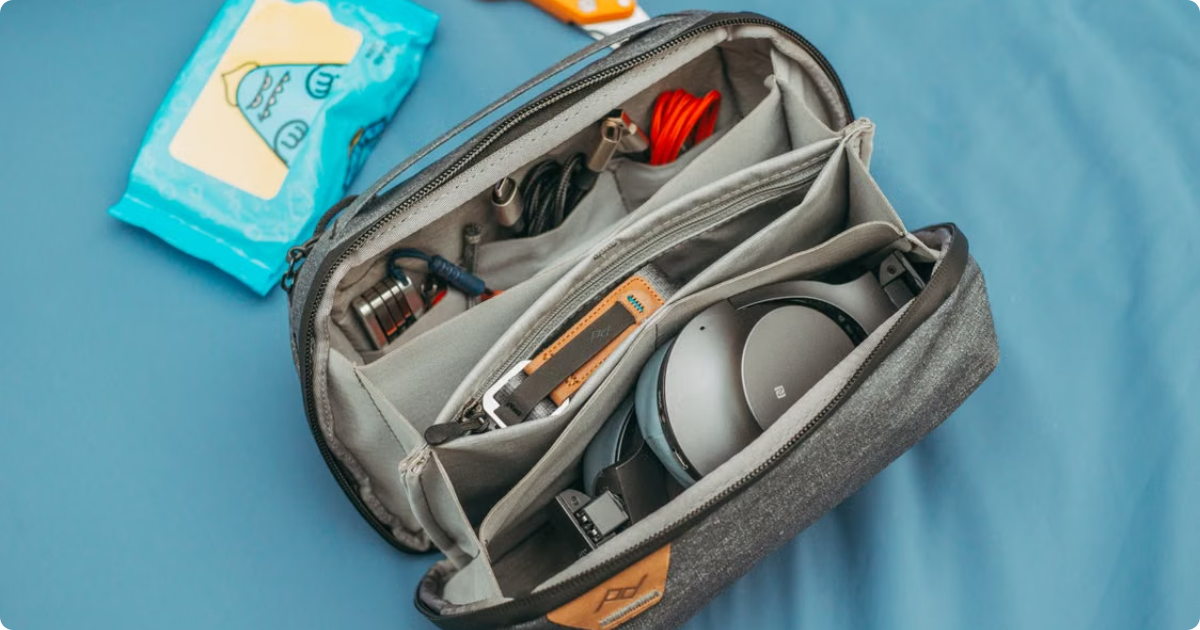
For work travelers, a slim tech organizer that keeps cables, adapters, and a power bank in one accessible sleeve integrates cleanly with a carry-on setup and eliminates the time spent hunting through bag pockets at security.
See our dedicated [Travel Essentials for Men] guide for specific recommendations by trip type.
Travel Tech Accessories Worth Carrying
Technology has produced some genuinely useful travel accessories in recent years, though the space is also full of gadgets that are impressive on spec sheets and largely useless in practice.
Portable Chargers and Power Strips
A travel power strip is a more useful purchase than many travelers realize. In hotel rooms, airport lounges, and Airbnb properties with limited outlets, a compact power strip with two or three outlets and USB ports turns one socket into a complete charging hub for an entire travel kit.
Look for surge-protected versions, which protect devices from electrical spikes common in some international destinations. Compact cube-style power strips are the most packing-efficient format.
Luggage Trackers
| Tracker | Compatible Ecosystem | Network |
|---|---|---|
| Apple AirTag | iPhone | Find My network |
| Tile | Android | Tile crowd-sourced network |
| Chipolo Pop | Android and Apple | Find My Device and Find My app |
Luggage trackers have moved from novelty to practical tool, particularly for checked bag travelers after a period when airlines experienced widespread bag mishandling.
Apple AirTags integrate seamlessly into the iPhone ecosystem and use the Find My network for location updates. For Android users, Tile trackers use a dedicated app and a separate crowd-sourced network. The Chipolo Pop is a notable cross-platform option that works with both Android’s Find My Device network and Apple’s Find My app, making it useful for mixed-device households.
At eight grams, a coin-sized tracker adds nothing measurable to bag weight. Placed inside a checked bag, it provides real-time location data and makes the process of reporting and recovering a lost bag significantly more efficient.
E-Readers
An e-reader deserves a place in this guide because it replaces multiple physical books while adding roughly 170 grams to a bag. For travelers who read, that trade-off is essentially always worth it.
Kindle devices integrate tightly with Amazon’s book ecosystem. Kobo devices support library borrowing through OverDrive in many countries, which means free access to books through a library card a meaningful advantage for longer trips. Kobo also offers a color screen option that renders maps and travel guidebooks more effectively than a black-and-white display.
Battery life on modern e-readers is measured in weeks rather than hours, which makes them one of the few electronic travel accessories that almost never need mid-trip charging.
Travel Accessories for Long Flights

| Challenge | Recommended Accessories |
|---|---|
| Sleep | Neck pillow, contoured eye mask, earplugs or noise-canceling earbuds, light blanket or large scarf |
| Comfort | Compression socks, lumbar support cushion, moisturizer, lip balm |
| Hydration | Reusable water bottle carried empty through security and filled at the gate |
| Productivity | Noise-canceling headphones, tablet or laptop, offline content library, laptop stand or travel tray |
Long-haul flights generally considered those over seven hours have specific discomforts that shorter flights don’t share. Preparation matters more, and the right accessories address the four main challenges: sleep, comfort, hydration, and productivity.
For sleep: a quality neck pillow, a contoured eye mask, earplugs or noise-canceling earbuds, and a light blanket or large scarf function as a complete sleep kit. Some travelers add melatonin or a prescription sleep aid; this guide focuses on gear rather than pharmaceuticals.
For comfort: compression socks are more important on long-haul flights than on shorter ones. A lumbar support cushion a small inflatable pad that supports the lower back addresses the ache that develops after several hours in economy seating. Moisturizer and lip balm help manage the dehydrating effects of cabin air.
For hydration: an empty reusable water bottle carried through security and filled at the gate ensures you have water available without depending on infrequent cabin service. Many long-haul flights allow you to request a full can of water or juice from the flight crew, but having a bottle removes the need to ask repeatedly.
For productivity: noise-canceling headphones, a tablet or laptop, and an offline content library (downloaded podcasts, shows, or e-books) support focused work or entertainment without depending on unreliable in-flight Wi-Fi. A laptop stand or travel tray that attaches to the tray table improves ergonomics significantly for anyone working through a long flight.
See our dedicated [Best Travel Accessories for Long Flights] guide for a complete breakdown.
Travel Accessories for Road Trips
Road trips have a distinct set of needs that air travel accessories don’t always address. The vehicle becomes the base of operations, and the accessories that matter most are those that improve the driving experience, manage in-car organization, and support overnight stops.
A car phone mount is foundational. A stable, secure mount that positions the phone at eye level for navigation eliminates the safety problem of a phone sliding on the dashboard or balanced on a seat. Magnetic mounts are the most convenient for frequent phone use; suction mounts on the windshield are stable and adjustable.
A car charger with multiple USB ports and USB-C Power Delivery keeps multiple devices charged without competition for outlets. Many modern vehicles have USB ports built in, but a dedicated charger with a higher wattage output charges devices significantly faster.
A soft-sided cooler that fits across the back seat floor keeps food and drinks accessible without stopping frequently. Collapsible versions stow flat when empty.
A roadside emergency kit jumper cables or a jump starter pack, a basic tool set, a reflective triangle, and a first aid kit is the category of road trip accessory most travelers assume they won’t need and are most grateful to have on the rare occasion they do.
For overnight stops, the same sleep accessories that work on flights transfer directly to road trip use: an eye mask, earplugs, and a travel pillow make a difference in unfamiliar accommodation.
See our dedicated [Road Trip Essentials and Packing List] guide for a comprehensive breakdown by vehicle type and trip length.
How to Choose Travel Accessories for Your Budget
Travel accessories span an enormous price range, and the relationship between price and quality is less consistent than in most other product categories. A few principles help regardless of budget.
Buy for durability first. A travel accessory that breaks on its second trip costs more than a more expensive option that lasts five years. This applies most strongly to bags, luggage, and anything with moving parts (zippers, locks, clasps). Check user reviews specifically for durability a product can photograph beautifully and fail quickly.
Buy one excellent version of the things you use constantly. A power bank, a set of headphones, and a travel wallet are used on every single trip. Spending more here makes more sense than spending on something used once a year. Buy less expensive versions of the things used occasionally.
Prioritize problem-solving over feature accumulation. The best travel kit is not the most comprehensive one it’s the one that solves your specific problems without adding unnecessary weight or complexity. A traveler who never sleeps on planes doesn’t need a premium neck pillow. A traveler who only does domestic road trips doesn’t need a universal adapter.
Test with your actual bag. Many travelers purchase accessories in isolation without checking whether they fit their specific bag configuration. Packing cubes, toiletry bags, and organizers all interact with the shape and dimensions of your main bag. Confirming compatibility before a trip saves money and frustration.
For a complete budget breakdown with specific picks at multiple price points, see our guides on [Best Luggage for International Travel] and [Best Travel Gadgets] within this silo.
Final Verdict
The best travel accessories are the ones you actually use, every trip, without thinking twice. That list is shorter than most roundups suggest and more personal than any single guide can fully capture.
Start with the fundamentals: a power bank, a good travel wallet, and compression socks cover the most common travel problems across almost every trip type. Add sleep accessories if you fly long-haul, a universal adapter if you travel internationally, and packing cubes if you live out of a carry-on. Every other addition is a trade-off between solving a real problem and adding weight to your bag.
The guides linked throughout this pillar go deeper on every category, with specific product comparisons, budget-segmented picks, and destination-specific recommendations. Use this page as the map and navigate to the specific guides for the details that matter most to your next trip.
