

Most Europe packing lists hand you a long checklist and call it a day. The problem is that what you need for a rainy week in Edinburgh is completely different from what makes sense for ten days along the Amalfi Coast. Cramming both into one generic list leads to overstuffed bags and still missing the right gear.
This guide takes a different approach. Instead of a one-size-fits-all master list, it walks you through the decisions that actually determine what belongs in your bag: where in Europe you are going, what season you will be traveling in, and how long you plan to stay. Get those three things right and the rest falls into place.
Why One Europe Packing List Does Not Fit All
Europe is not a single destination. It is a continent of more than 40 countries spread across dramatically different climates, cultures, and terrain. Summer in Portugal looks nothing like summer in Norway. A weekend in Amsterdam requires different gear than a three-week backpacking trip through the Balkans.
The clothing norms vary too. Southern Europeans tend to dress up even for casual outings. Nordic cities lean toward practical and understated. Religious sites across Italy, Greece, and Spain require covered shoulders and knees regardless of the temperature outside. Ignoring these differences leads to the single most common packing mistake Americans and Brits make: packing for a fantasy Europe rather than the specific place they are actually visiting.
Cobblestone streets also deserve a word here. They run through virtually every historic city center on the continent, from Lisbon to Krakow. Footwear that works beautifully in a shopping mall can become unbearable after two hours on uneven stone. Your shoe choices matter more in Europe than almost anywhere else.
The Three Questions That Should Drive Every Packing Decision
Before you open your suitcase, answer these:
Where are you going? The region of Europe determines your climate baseline, dress code expectations, and whether you need items like hiking boots, a packable rain shell, or light sandals.
What season will you be traveling? Seasons in Europe are pronounced. Spring is unpredictable. Summer in the south can be intense heat with little air conditioning. Northern winters are dark and raw. Each season calls for a fundamentally different wardrobe.
How long is your trip? A week-long city break and a three-week multi-country trip require completely different luggage strategies. Laundry access changes the equation significantly for longer journeys.
Every packing recommendation in this guide flows from these three questions.
What to Pack for Europe: The Universal Essentials
Certain items belong in every European travel bag regardless of destination, season, or trip length. These are your non-negotiables.
Clothing Foundations
Build your wardrobe around neutral, mix-and-match pieces. European cities, particularly in France, Italy, and Spain, have a noticeably polished everyday dress standard. Athleisure wear and oversized hoodies stand out in ways that can draw unwanted attention and mark you clearly as a tourist.
Choose fabrics that breathe, move well, and dry quickly. Merino wool is exceptional for travel because it regulates temperature, resists odor, and compresses well. Linen works beautifully in warm climates. Synthetic blends like polyester-nylon are practical for hiking and adventure days but look out of place at a nice restaurant or a cathedral.
The layering principle is your single most powerful packing tool. European weather shifts throughout the day, and moving between countries can mean moving between climates. A lightweight base layer, a mid-layer like a cardigan or light sweater, and a packable outer shell give you enormous flexibility without taking up much space.
For most trips, the following clothing foundation covers the majority of situations:
- Four to five tops (mix of short and long sleeve)
- Two pairs of bottoms (pants, jeans, or skirts depending on preference)
- One versatile dress or smart casual outfit for evenings
- One lightweight sweater or cardigan
- One packable, water-resistant jacket with a hood
- Seven days of underwear (plan to do laundry on trips longer than a week)
- Three to four pairs of socks, including at least one wool pair for cooler days
- A scarf, which doubles as warmth, a cover-up at religious sites, and a light blanket on overnight trains
Footwear
Limit yourself to two or three pairs maximum. One should be a well-broken-in walking shoe or comfortable sneaker that you could wear comfortably for 15,000 to 20,000 steps. European sightseeing days are long, and your feet will make the difference between a great day and a miserable one.
A second pair for evenings a low-heeled boot, loafer, or clean leather sandal covers dinners, theater visits, and upscale venues. A third pair is optional and depends on your itinerary: sandals for Mediterranean beach trips or waterproof hiking boots for alpine or wet northern regions.
Never pack shoes you have not already worn for extended periods. Breaking in new footwear while covering 10 miles of cobblestone is a reliable way to ruin a trip.
Travel Accessories and Security
A money belt or hidden security pouch worn under clothing is strongly recommended. Pickpocketing is common in high-traffic tourist areas across all major European cities, including Paris, Rome, Barcelona, and Prague. Keeping your passport, backup cards, and emergency cash against your body removes the most common target.
A lightweight daypack handles everything you need during sightseeing hours. Look for one with a water-resistant exterior and secure zipper pockets. Avoid wearing backpacks on your back in crowded metro stations and markets wear them on your front or use a crossbody bag in high-density tourist areas.
Packing cubes make a significant difference in organization and compression, especially on longer trips. A small padlock for hostel lockers or zipped luggage adds a practical layer of security.
Electronics and Connectivity
A universal European plug adapter is essential. Europe uses the round two-pin Type C plug in most countries, though the UK and Ireland use the three-pin Type G. If you are moving between the UK and continental Europe, you need adapters for both.
A portable power bank keeps your phone alive through long sightseeing days when finding an outlet is not always convenient. A lightweight pair of noise-canceling headphones or good earbuds makes long train journeys and overnight flights significantly more comfortable.
Download offline maps via Google Maps or Maps.me before you land. European roaming charges and spotty countryside connectivity make offline access genuinely valuable.
Toiletries and Health Essentials
Pack only what you cannot easily buy in Europe. Most European pharmacies and supermarkets carry standard toiletries, though brand names may differ. European pharmacies typically stock ibuprofen and paracetamol, not Advil and Tylenol, so ask for the generic ingredient name if you need pain relief.
A small first-aid kit should include blister plasters, pain relief, antihistamine, and any prescription medications in their original packaging. Bring enough prescription medicine for the full trip plus a few extra days.
Sunscreen is worth bringing from home, particularly for Southern European summer travel. It is available in Europe but can be expensive in tourist areas.
A packet of tissues is genuinely useful in a continent where public bathroom paper supplies are often minimal or absent.
Documents and Money
Your passport, travel insurance documents, and any required visas should be kept on your person or in your hotel safe. Carry a photocopy or digital scan of your passport separately.
Notify your bank before you travel. A credit card with no foreign transaction fees saves money across the board. Cash is still essential in smaller towns, markets, and some rural restaurants, so keep a moderate amount of local currency on hand. Euro is accepted across most of the EU, but Czechia, Poland, Hungary, Sweden, and the UK each use their own currency.
Packing for Europe by Season
Spring (March to May)
Spring in Europe is beautiful and deeply unpredictable. Temperatures vary sharply between regions and can shift significantly within a single week. Rain is common across most of the continent through April and into May.
A waterproof jacket with a hood is non-negotiable for spring travel almost anywhere in Europe. Layer underneath with a light sweater and base tops. Closed-toe shoes or water-resistant sneakers handle wet streets far better than sandals.
In Southern Europe, spring warms earlier. Greece and southern Spain can feel genuinely warm by late April, allowing lighter layers and even sandals for warmer afternoons. In Northern Europe, particularly in Scandinavia, Iceland, and the UK, spring temperatures remain cool and wet well into May.
The Alps and mountain regions can still have snow into April and early May. Pack warmer base layers and waterproof footwear if your itinerary includes higher elevations.
Summer (June to August)
Summer is peak season across Europe, and the packing requirements split sharply by region.
In the Mediterranean south Italy, Greece, Spain, Portugal, Croatia summers are hot and sunny. Lightweight, breathable fabrics are essential. Linen, cotton, and moisture-wicking synthetics work best. A sun hat, high-SPF sunscreen, and a reusable water bottle matter more here than almost anywhere else on the continent. Sandals with support are appropriate daywear. One thing many visitors underestimate: air conditioning is far less common in Europe than in the US or UK. Rooms, restaurants, and even some museums run warm. Light-colored, loose clothing makes a real difference.
In Western and Central Europe France, Germany, the Netherlands, Austria summers are warm and pleasant but can include rainy days. Pack a light layer for museums, which tend to run cool, and a compact umbrella or packable rain jacket.
In Northern Europe, including Scandinavia, Iceland, and Scotland, summer temperatures are mild and often surprisingly cool by late afternoon. A light fleece or sweater and a windproof shell are sensible even in July. Northern summer also brings very long daylight hours a sleep mask helps enormously for anyone sensitive to light.
Fall (September to November)
Fall is one of the most rewarding times to travel Europe, with thinner crowds and softer light. It is also the season that most catches travelers underprepared.
September in Southern Europe is still warm and often beautiful, closely resembling a late summer trip. By October, evenings cool significantly and coastal weather becomes less reliable. A medium-weight layer, a rain shell, and comfortable boots become the right combination.
Western and Central Europe turns noticeably cooler by October. A warm sweater, scarf, and water-resistant shoes are the backbone of a fall wardrobe. By November, an insulated or down packable layer makes sense.
The UK and Atlantic-facing coasts tend toward wet and windy falls. Prioritize waterproof and windproof outerwear over heavy insulation. Staying dry matters more than staying warm in these climates.
Winter (December to February)
Winter packing for Europe requires the most deliberate layering strategy of any season. The key insight is that what keeps you warm inside is usually different from what keeps you warm outside, and European interiors including some hotels, churches, and older buildings are often less heated than North Americans or Brits expect.
In Northern and Central Europe, including Germany, Austria, Poland, and Scandinavia, winters are genuinely cold. An insulated waterproof coat, thermal base layers, wool socks, a hat, gloves, and waterproof boots are practical necessities, not optional extras.
In the UK and Ireland, winters are wet and cold rather than bitterly cold. Waterproof and windproof outer layers matter more than heavy insulation. A good mid-layer and waterproof footwear cover most days.
In Mediterranean cities Rome, Barcelona, Athens, Lisbon winters are mild by continental standards but damp. A medium-weight coat, scarf, and rain shell handle most conditions. Closed-toe shoes are appropriate, and evenings can be genuinely chilly.
If your itinerary includes ski destinations in the Alps, Dolomites, or Pyrenees, rent bulky gear like ski jackets, helmets, and ski pants on the mountain rather than packing them. Bring your own base layers, wool socks, and neck gaiter for warmth and comfort.
Packing for Europe by Region
| Season | Key Clothing Items | Footwear | Critical Add-Ons |
|---|---|---|---|
| Spring (Mar–May) | Layered tops, light sweater, mid-layer | Closed-toe, water-resistant shoes or sneakers | Waterproof hooded jacket, compact umbrella |
| Summer (Jun–Aug) | Lightweight breathable tops, linen or cotton bottoms, one light layer for museums | Supportive sandals, broken-in walking shoes | Sun hat, high-SPF sunscreen, reusable water bottle, sleep mask (northern regions) |
| Fall (Sep–Nov) | Warm sweater, scarf, packable insulated layer (by late fall) | Closed-toe shoes or boots, water-resistant soles | Waterproof and windproof outer shell, rain-ready footwear |
| Winter (Dec–Feb) | Thermal base layers, insulating mid-layer, wool socks | Waterproof boots with traction | Insulated coat, hat, gloves, scarf; rent ski gear rather than packing it |
Southern Europe
Southern Europe Italy, Spain, Portugal, Greece, Croatia, and the western Balkans rewards light, stylish packing. The culture favors a dressed-up aesthetic even for casual days. Sundresses, linen trousers, lightweight blouses, and leather sandals fit the environment naturally.
Religious sites are everywhere across this region, and most have dress codes. Pack a scarf or light wrap that can cover shoulders and knees. Many churches keep spare coverings at the door, but having your own saves time and avoids the rental charge.
Summers here are intensely sunny. High-SPF sunscreen, a wide-brimmed hat, and a reusable water bottle protect you during long days of walking through exposed ruins, clifftop towns, and open markets.
Western and Central Europe
This region includes France, Germany, the Netherlands, Belgium, Austria, Switzerland, and the Czech Republic. Weather is more variable year-round than the south, and the style expectations lean smart-casual rather than beach-resort.
Pack for versatility. Neutral-toned, layerable clothing handles both a morning at a museum and an evening at a Parisian bistro. A waterproof jacket earns its space in any season. Comfortable walking shoes with solid tread handle both city streets and countryside paths.
Paris specifically rewards slightly more polished dressing. The city has a reputation for style-consciousness that is mostly earned casual doesn’t mean sloppy in most French contexts.
Northern Europe
Northern Europe the UK, Ireland, Scandinavia, Iceland, Finland requires weather-first thinking regardless of the time of year. Pack a waterproof, windproof outer layer as your baseline assumption. Everything else layers underneath.
For Ireland and Scotland specifically, pack as if it will rain at some point every day. This is not pessimism it is practical. A waterproof jacket, quick-drying fabrics, and water-resistant footwear keep you comfortable rather than miserable.
Iceland warrants its own mention for outdoor adventures. Layering is essential here: a moisture-wicking base, an insulating mid-layer, and a waterproof shell cover everything from a mild summer hike to a winter Northern Lights expedition. Bring or rent waterproof hiking boots for any outdoor activity beyond city walking.
Eastern Europe
Eastern Europe Poland, Hungary, Romania, Bulgaria, the Baltic states, and the western Balkans combines affordability with genuine seasonal extremes. Summers can be warm and sunny; winters are often cold and sometimes harsh.
Pack by season more than region here, as the climate varies significantly by country and elevation. Budget-friendly laundry options are widely available, making it easy to pack lighter and wash more frequently on longer trips.
Dress codes at religious sites, particularly Orthodox churches, are often stricter than in Western Europe. Women are typically expected to cover their heads as well as shoulders and knees. A lightweight scarf handles all of these requirements in one item.
Europe Packing List by Trip Length
One Week in Europe
A week in Europe is best tackled with a single carry-on bag if possible. Most major European cities are walkable and well-connected by public transport, so moving between accommodations with a compact bag is noticeably easier than wrestling with checked luggage.
Pack five or six tops, two pairs of bottoms, one evening outfit, enough undergarments for the week, and your two primary pairs of shoes. A small daypack handles everything you need during sightseeing hours. You do not need to plan for laundry on a seven-day trip simply pack enough for each day.
Two Weeks in Europe
Two weeks typically means visiting multiple cities or countries, which increases both the variety of activities and the need for efficient packing. Plan to do laundry once, around the midpoint of your trip. Most European hotels can arrange laundry service, and self-service launderettes are widely available in all major cities.
With one mid-trip laundry round planned, a week’s worth of clothing is sufficient. The key additions for a two-week trip are a slightly wider footwear selection to handle varied activities, and a few extra layers if you are crossing between climate zones for example, moving from the Scottish Highlands to southern France.
Three Weeks or More
On trips longer than three weeks, the packing calculus shifts entirely toward versatility and laundry frequency rather than volume. Experienced long-term Europe travelers typically carry no more than what fits in a 40-liter backpack, regardless of how many weeks they will be away.
Plan to do laundry every five to seven days. Pack a small travel-size laundry detergent bar or liquid for sink washing of light items between laundromat visits. Choose fabrics that dry overnight merino wool and quick-dry synthetics earn their place on long trips in a way that cotton does not.
Compression packing cubes help maximize space. Leave room in your bag for purchases you make along the way a small packable tote folds flat and solves the souvenir problem without adding meaningful weight.
Europe Packing List for Women
| Trip Length | Luggage Strategy | Clothing Volume | Laundry Plan |
|---|---|---|---|
| One Week | Single carry-on bag | Five to six tops, two pairs of bottoms, one evening outfit | Not needed — pack enough for each day |
| Two Weeks | Carry-on with slightly wider footwear selection | One week’s worth of clothing | Once at the midpoint of the trip |
| Three Weeks or More | 40-liter backpack maximum | Core versatile wardrobe; merino wool and quick-dry fabrics | Every five to seven days; travel detergent for sink washing |
Women traveling Europe have a few specific considerations beyond the universal essentials.
A versatile dress that can dress up or down handles an enormous range of occasions. One well-chosen dress paired with different shoes, a scarf, and a change of accessories covers casual sightseeing days and nicer evenings without needing a separate outfit for each.
A crossbody bag with a secure clasp and internal zipper pockets is both practical and widely used across Europe. It keeps your hands free, your belongings secure, and draws far less attention than a camera bag or obvious tourist daypack in crowded areas.
White sneakers are genuinely one of the most versatile footwear choices for European travel. They are comfortable, accepted in most settings from cafes to cathedrals, and work with almost every outfit combination. Avoid stilettos or thin-soled heels cobblestones are unforgiving.
For solo female travelers, a portable door alarm or door lock adds a practical layer of security in hostels and budget accommodations. Leave expensive or sentimental jewelry at home. A simple, inexpensive ring can be useful in certain situations as a deterrent.
Pack feminine hygiene products in your carry-on if you have brand preferences. European pharmacies stock these items, but specific brands may not be available in smaller towns.
Europe Packing List for Men
Men’s packing for Europe benefits from the same layering and versatility principles as everyone else, with a few specific callouts.
A pair of dark, well-fitted chinos or trousers works far harder than jeans for most European contexts. They are acceptable at upscale restaurants, dress codes at nicer venues, and are lighter and faster-drying than heavy denim. Reserve jeans for casual days or travel days if you prefer them.
Sports jerseys, baseball caps, and logo-heavy athletic wear tend to mark travelers as tourists and occasionally attract attention in the wrong ways. Pack at least two or three plain, well-fitting tops that could pass as casual European streetwear.
A slim travel wallet or card holder inside a front pocket is more secure than a traditional wallet in a back pocket, particularly in crowded areas like metro stations and markets.
For men visiting French pools or public baths, be aware that swim shorts are not permitted in many French public pools Speedo-style swimwear is the required standard.
What Not to Pack for Europe
Overpacking is the most consistent mistake European travelers make, particularly on first trips. These items are either unnecessary, available to buy in Europe, or actively make your trip harder.
Heavy guidebooks can be downloaded as apps or ripped into relevant chapter sections. Carrying the full weight of a 600-page guidebook is rarely worth it.
A travel iron is unnecessary. European hotels provide them on request if truly needed, and wrinkle-resistant fabrics eliminate the problem at the packing stage.
Multiple pairs of heels or dress shoes take up disproportionate space relative to how often they are actually worn. One versatile evening shoe handles almost every situation.
Excessive electronics and charging accessories are a common source of bag weight. Most people use two to three devices maximum pack accordingly and share cables where possible.
Full-size toiletry bottles eat luggage space and trigger security checks. Transfer to travel-size containers or buy what you need on arrival. European pharmacies and supermarkets stock everything you need.
Packing Light for Europe: How to Do It Right
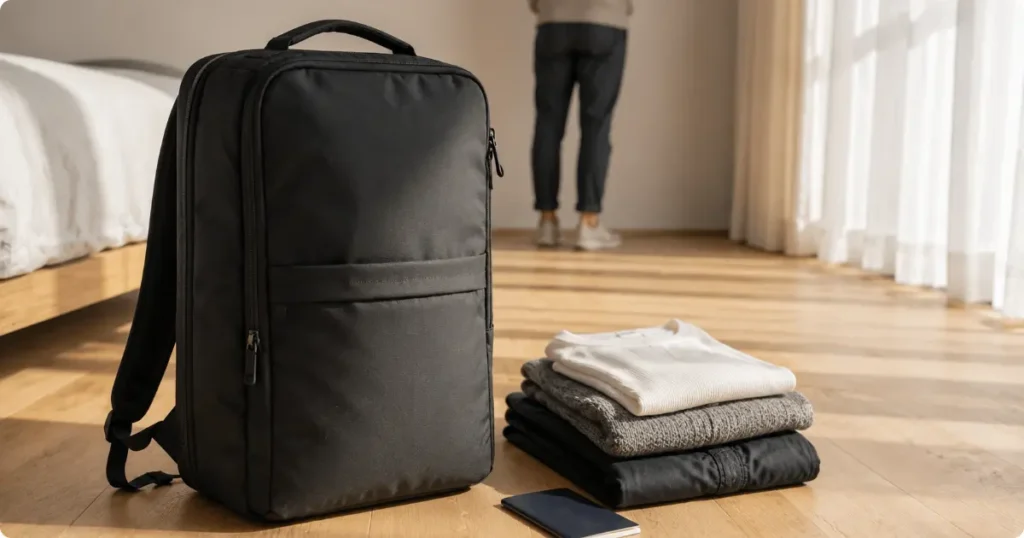
Traveling light is not about deprivation it is about choosing smarter. Experienced European travelers consistently identify the same advantages: moving between cities without checking luggage, skipping baggage carousels, and navigating cobblestone streets without wrestling with an oversized rolling bag.
The most reliable method is to lay out everything you plan to pack, then remove roughly a third of it. Most travelers consistently overestimate what they will actually use. The reality is that many people rotate through a small core wardrobe for the entire trip, with the rest serving as expensive ballast.
Neutral colors multiply your outfit options without multiplying your bag weight. A black pair of trousers, a grey sweater, and white and navy tops create a surprising number of combinations that all look reasonably put-together.
Laundry, not luggage volume, is the real solution for long trips. Committing to washing clothes mid-trip, even once, cuts your required clothing in half. Most European accommodations can help arrange this, and self-service launderettes are standard in every city.
Carry-on travel is achievable on almost any European trip shorter than three weeks with deliberate planning. Airlines like Ryanair and EasyJet have strict carry-on size limits, so verify dimensions before packing if you are taking budget European flights between cities.
Final Verdict
A good Europe packing list is not a comprehensive inventory of everything you might conceivably need it is a set of deliberate choices built around where you are going, what season you will experience, and how long you will be away. Get those three variables right and you will carry only what actually helps you.
Pack neutral, layerable clothing. Bring one pair of truly comfortable walking shoes. Secure your documents and valuables properly. Plan for laundry rather than volume on longer trips. Skip the extras you have convinced yourself are essential but will never actually reach for.
The travelers who enjoy Europe most are almost never the ones with the largest bags. They are the ones who move easily, adapt readily, and spend their energy on the trip itself rather than managing what they brought with them.
